Turkey Substitutes: What to Use Instead in Every Recipe
Turkey is not always easy to get hold of, and even when it is, it is not everyone’s favourite. Maybe your usual shop is out of stock, maybe you find turkey a bit dry and bland, or maybe it is just priced like a special occasion when you only wanted a normal Tuesday dinner.
As an Amazon Associate I earn from qualifying purchases and sometimes recommend products from other sellers at no extra cost you. For more details see my disclosure policy and privacy policy.
Whatever the reason, there is almost always a substitute that works just as well, whether you are replacing a whole roast, mince (ground turkey), or turkey breast and cutlets. Here is exactly what to reach for, cut by cut.
🍗 Substitutes for a Whole Roast Turkey
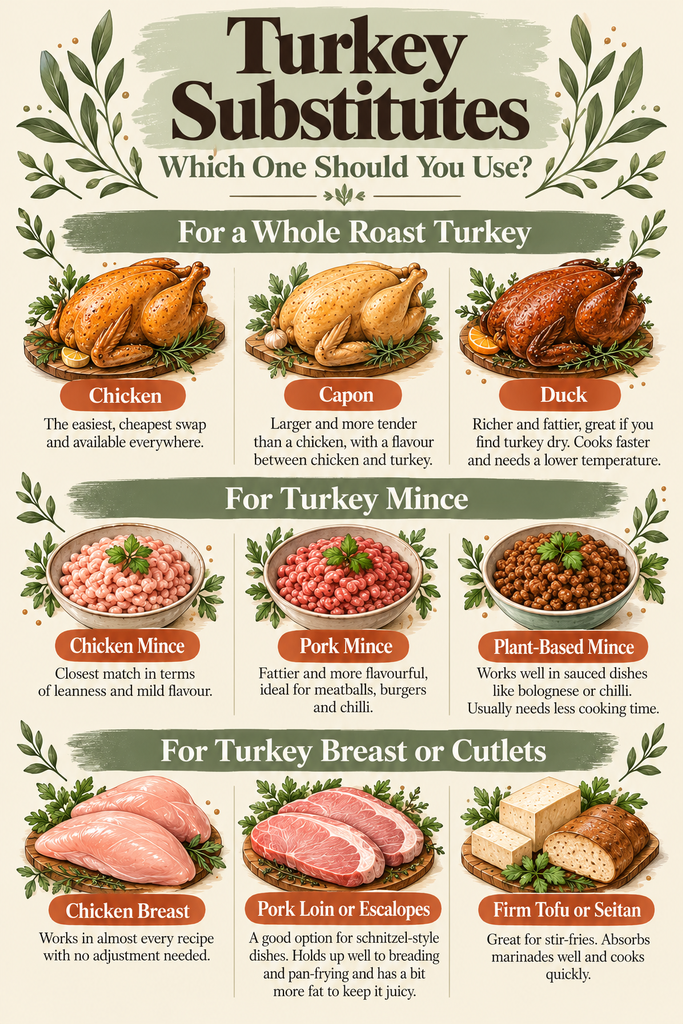
If your recipe calls for a whole roast turkey, your best swaps are chicken, capon, or duck, depending on the size and richness you want.
- Roasting chicken: the easiest, cheapest swap, and available everywhere. Roast at 200°C (180°C fan) for about 20 minutes per 500g, plus 20 minutes, until the thickest part of the thigh reaches 74°C.
- Capon: a larger, more tender bird that sits between a chicken and a turkey in size, and a genuinely underrated substitute if your shop stocks one. Roast at 230°C for the first 30 minutes to brown the skin, then drop to 180°C and cook for around 17 minutes per pound, until it hits 74°C in the thigh.
- Duck: much richer and fattier than turkey, so it suits people who find turkey dry rather than those trying to recreate it exactly. Duck cooks faster than turkey and needs a lower oven temperature to render the fat properly, so keep a close eye on it rather than following turkey timings.
A reliable meat thermometer matters more here than usual, since none of these substitutes share turkey’s exact cooking time, and going by the clock alone is how you end up with a dry bird or an undercooked one.
Capon is worth a special mention here, because most people have never cooked one and assume it will behave like a small turkey. It actually roasts more like a very well-fed chicken. The skin browns faster than turkey skin does, so tent it loosely with foil once it reaches a deep golden colour if the rest of the bird still needs time. Ask a butcher rather than expecting to find one on a supermarket shelf, since capon is a specialty order in most areas.
Duck needs a slightly different approach altogether. Score the skin lightly before roasting so the fat underneath can render out as it cooks, and drain that fat from the tray part way through if it starts pooling, both for a crisper finish and because a shallow layer of hot fat around the bird slows down browning.
🥩 Substitutes for Turkey Mince (Ground Turkey)
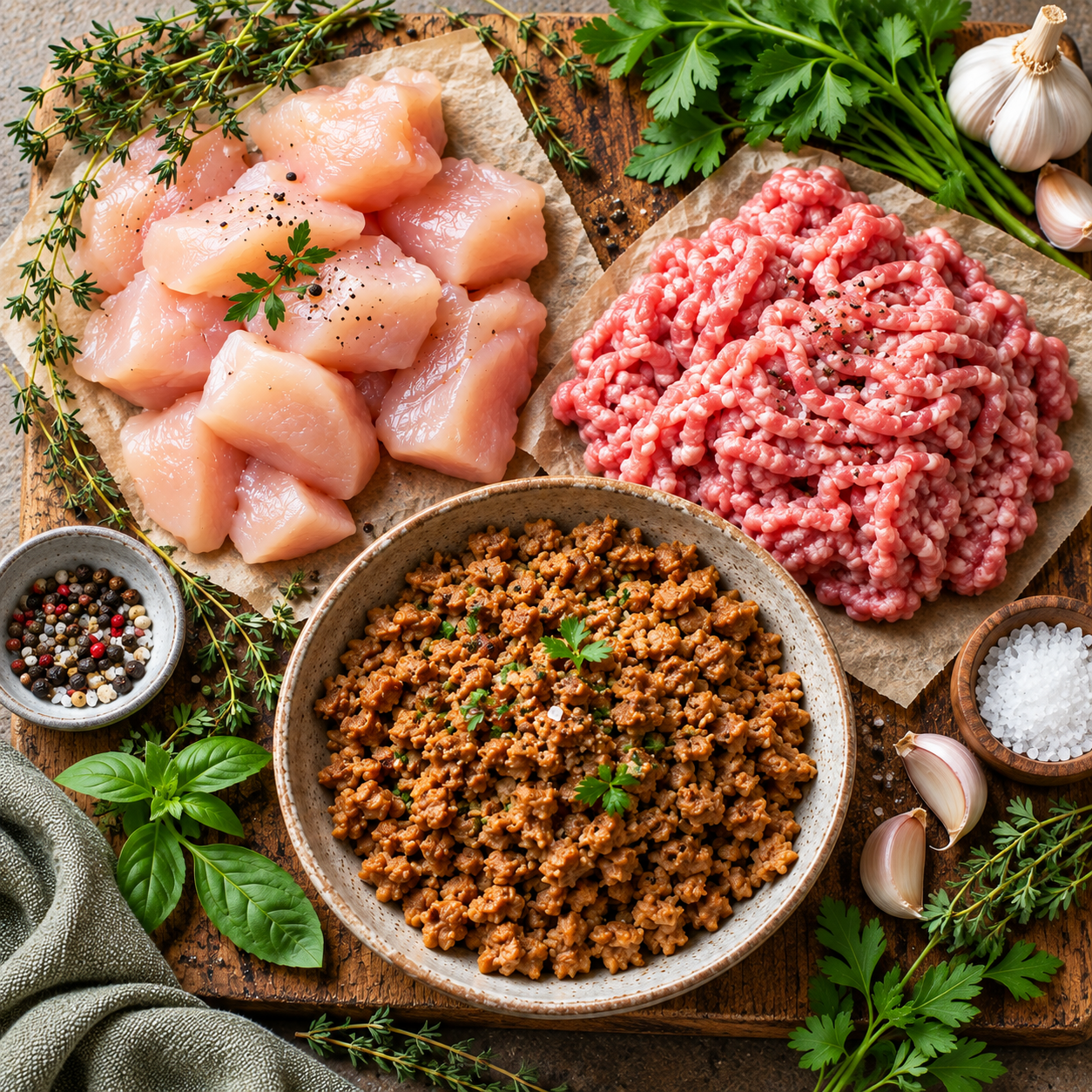
Turkey mince (ground turkey) is common in bolognese, burgers, meatballs, and chilli, and it swaps out easily.
- Chicken mince: the closest match in terms of leanness and mild flavour. It can turn slightly rubbery if overcooked, so cook it just until no longer pink rather than pushing it further.
- Pork mince: fattier and more flavourful than turkey, which actually helps in dishes like meatballs or burgers where turkey mince can dry out. Cut back slightly on any added oil if you swap in pork.
- Plant-based mince: works well in sauced dishes like bolognese or chilli, where it takes on flavour from everything around it. It generally needs less cooking time than turkey mince, so add it later in the process rather than browning it upfront the same way.
Whichever you choose, season a little more assertively than you would for turkey. Turkey mince is mild enough that recipes often lean on its blandness as a blank canvas, and a substitute with more flavour of its own can throw that balance off if you do not adjust.
Colour is the other thing worth knowing about before you start cooking. Turkey mince cooks up pale, almost the same colour raw and cooked, which throws some people off when they swap in chicken mince and see the same pale result, or swap in pork or beef mince and see it brown properly. Neither is a sign anything has gone wrong. It is simply how each meat behaves, and it has no bearing on whether the dish is actually done, so always check with a thermometer or by cutting a piece open rather than judging by colour alone.
Chicken mince also has a habit of clumping together in the pan more than turkey mince does. Break it up with a wooden spoon or spatula in the first couple of minutes of cooking, before it has a chance to set into larger lumps, and it will brown much more evenly.
🍽️ Substitutes for Turkey Breast and Cutlets
For turkey breast or cutlets in everyday dishes like schnitzels, stir-fries, or sandwiches, chicken breast is the obvious swap, but it is not the only one.
- Chicken breast: works in almost every recipe written for turkey cutlets with no adjustment needed, since the two cook almost identically.
- Pork loin or pork escalopes: a good option for schnitzel-style dishes specifically, since pork holds up well to breading and pan-frying and has a bit more fat to keep it juicy.
- Firm tofu or seitan (for stir-fries): absorbs marinades well and cooks quickly, making it a solid swap in a stir-fry where the sauce is doing most of the flavour work anyway.
For sandwiches, chicken breast is really the only substitute worth using. Turkey’s appeal in a sandwich is largely about its mild flavour and texture, and chicken is the only one of these options that matches both closely enough to not change the sandwich significantly.
If you do go with tofu or seitan for a stir-fry, give it longer in the marinade than you would give turkey. Turkey absorbs flavour quickly because it is naturally quite porous, while tofu needs at least 20 to 30 minutes, and seitan benefits from even longer, to properly take on the sauce rather than tasting bland in the middle of an otherwise well-seasoned dish.
❓ Turkey Substitute FAQs
What’s the closest overall substitute for turkey? Chicken, by a clear margin. It matches turkey closely enough in flavour, texture and cooking behaviour that most recipes need no other adjustment beyond checking temperature rather than relying on turkey’s timing chart.
Can I use beef instead of turkey? Not usually, no. Beef has a much stronger, richer flavour that changes the character of most turkey dishes rather than simply standing in for it. It can work in specific dishes like a bolognese or chilli where the sauce carries most of the flavour, but it is not a like-for-like swap the way chicken is.
Does turkey mince taste different from chicken mince once it’s cooked? Slightly, though most people would not notice in a well-seasoned dish. Chicken mince is a touch milder, which is why seasoning a little more generously than the original recipe calls for helps close that gap.
Is duck a good substitute if I actually like turkey and just can’t find any? Not really, no. Duck is much richer and fattier, so it changes the dish rather than replacing turkey invisibly. It is a better choice if you find turkey a bit dry or bland and want something with more character, rather than if you are trying to recreate turkey as closely as possible.
⚖️ Flavour and Texture at a Glance
Not every substitute behaves the same once it hits the pan or the oven, so here is how they actually compare to turkey.
| Substitute | Closest to turkey in flavour | Closest to turkey in texture | Best for |
|---|---|---|---|
| Chicken | Yes | Yes | Almost everything |
| Capon | Yes | Yes | Whole roasts |
| Duck | No, much richer | No, fattier | Roasts, if you like richer meat |
| Pork | No, sweeter and fattier | Close | Mince, schnitzels |
| Plant-based mince | Depends on brand | Close in sauced dishes | Bolognese, chilli |
💰 Budget and Availability
Turkey often costs more than chicken outside the holiday season, partly because demand and supply are so seasonal that shops do not always keep it stocked or priced competitively the rest of the year.
Chicken solves both problems at once. It is almost always in stock, usually the cheapest option on this list, and works as a substitute in nearly every turkey recipe without any real compromise. If budget is the main reason you are swapping turkey out, start there before looking at pork, duck, or plant-based options.
🔁 Quick Reference: Swap Ratios
Use these as your starting point, then adjust cooking time based on the actual size and thickness of what you are cooking.
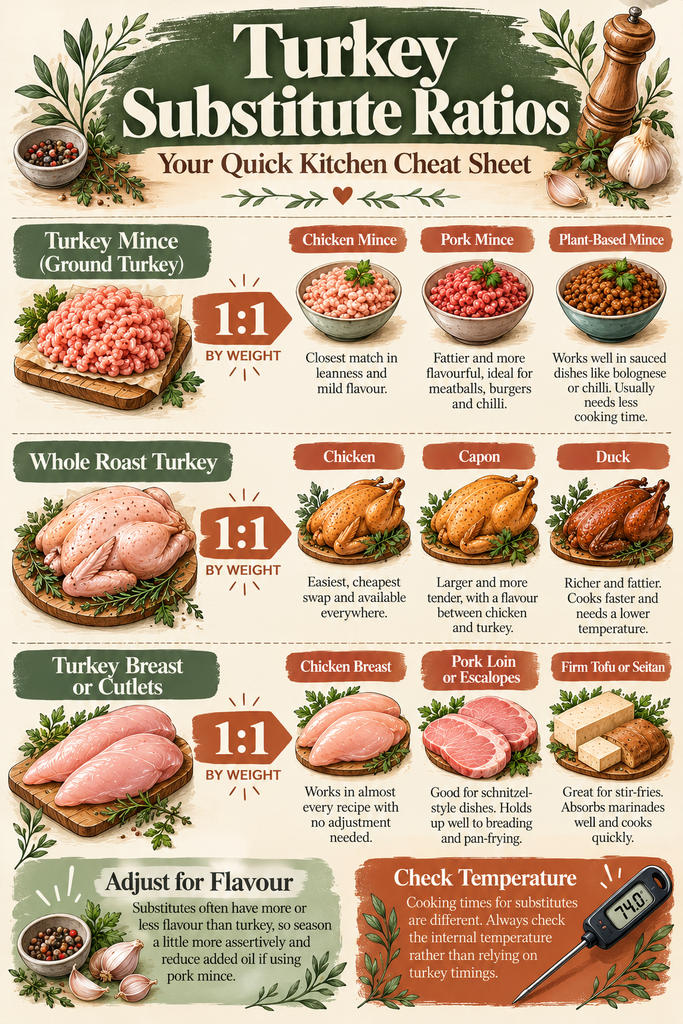
- Whole roast turkey → chicken: 1:1 by weight, but check temperature rather than relying on turkey’s timing chart.
- Whole roast turkey → capon: 1:1 by weight, roast temperature the same as above.
- Turkey mince → chicken mince: 1:1, season a little more generously.
- Turkey mince → pork mince: 1:1, reduce any added oil slightly.
- Turkey breast/cutlets → chicken breast: 1:1, no other adjustment needed.
- Turkey breast/cutlets → pork loin: 1:1 by weight, works best for breaded or pan-fried dishes.
Once you have settled on your substitute, you might still end up with real turkey in the fridge from time to time, and when you do, our guide to 6 things to do with turkey and its leftovers is worth a look. For the same swap-it-out logic applied to a different protein, our chicken substitute guide and beef substitutes guide cover many of the same budget and availability questions.