How to Choose the Best Cocktail Shaker for Your Home Bar
The best cocktail shaker for most home bartenders is a weighted Boston shaker, which is two steel tins, paired with a separate Hawthorne strainer. If you only make the odd drink and want a single piece of kit that does everything, a cobbler shaker will do the job.
As an Amazon Associate I earn from qualifying purchases and sometimes recommend products from other sellers at no extra cost you. For more details see my disclosure policy and privacy policy.
Shakers look alike on the shelf but behave very differently once they are full of ice. This guide covers the three main types, which size to buy, how to use one properly, what to do when it sticks or leaks, and what to grab if you do not own one yet.
What are the different types of cocktail shakers?
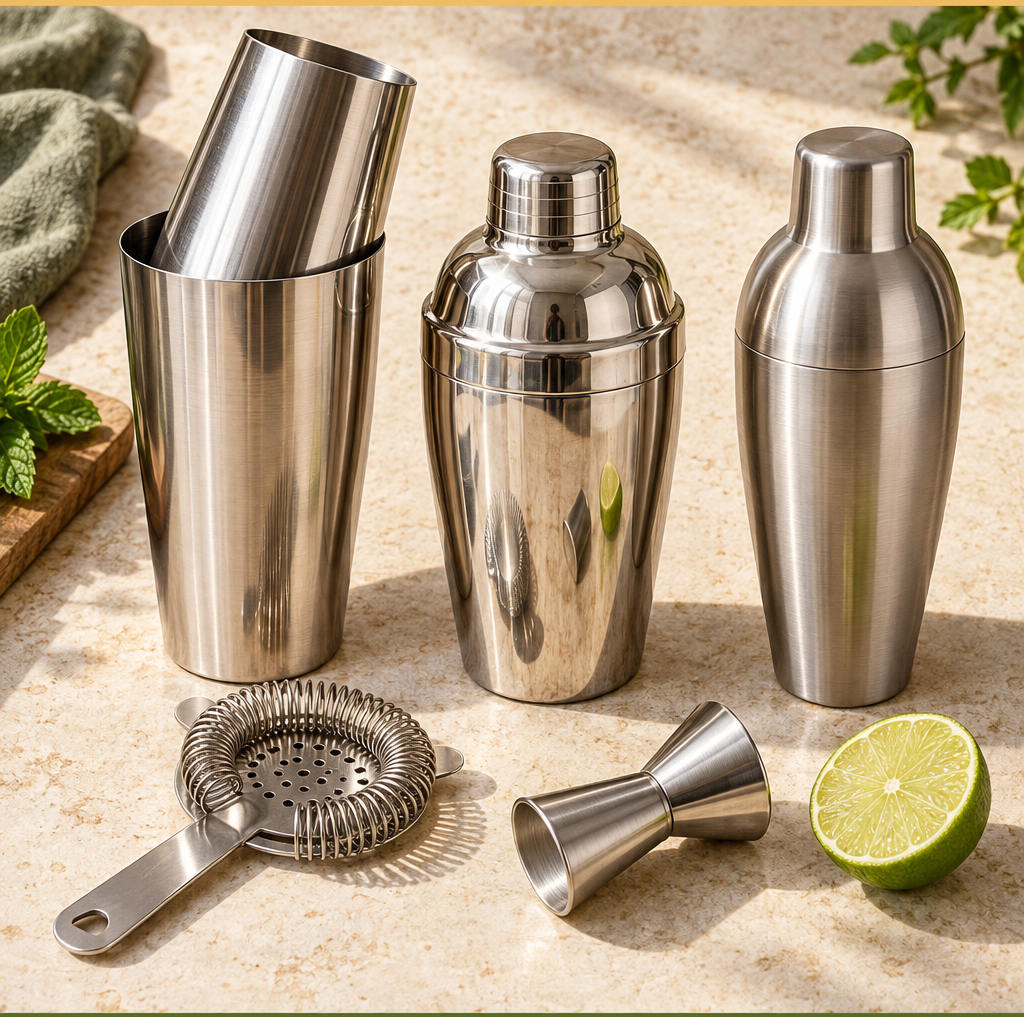
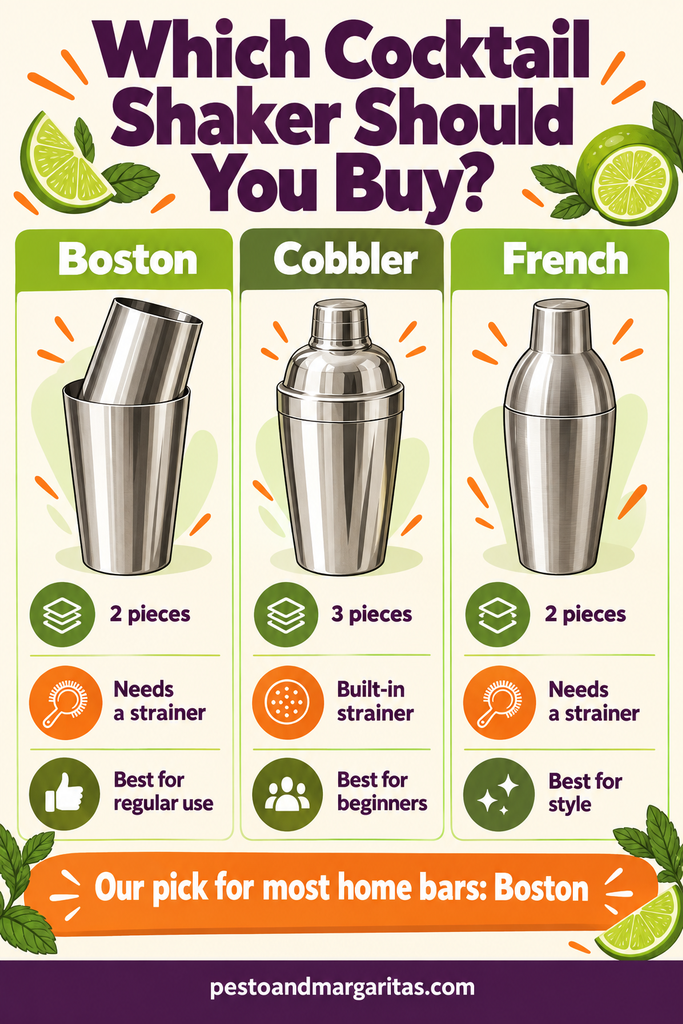
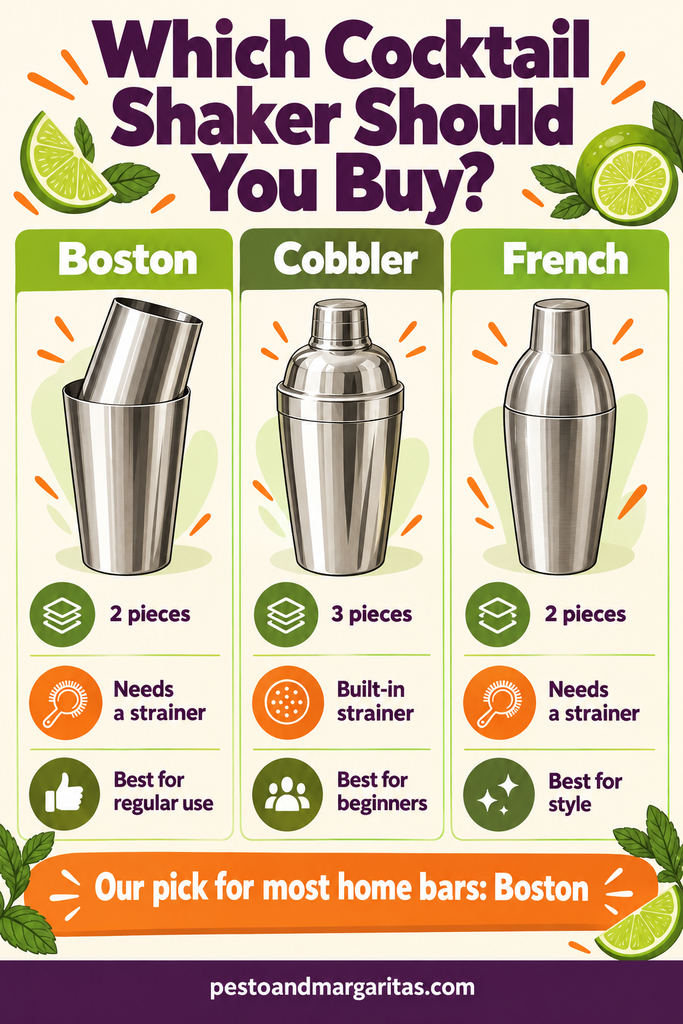
Three designs have lasted since the nineteenth century: the Boston, the cobbler and the French shaker, also called the Parisian. Shop labels get muddled, so count the pieces rather than trusting the name.
The Boston shaker
A Boston shaker is two tins, one larger than the other. You build the drink in the smaller tin, fit the larger tin over the top and give it a firm tap to seal. Most bars use this style because it is fast, holds plenty of ice and is easy to wash.
The usual pairing is an 18 oz tin (about 530 ml) and a 28 oz tin (about 830 ml). Some sets swap one tin for a glass, but I would stay with two steel tins at home, because glass can chip or shatter. A weighted large tin feels steadier in the hand and chills the drink fast.
- Good: there is no cap to jam, the wide openings are easy to clean and the tins can be replaced one at a time.
- Not so good: you need a separate strainer, the seal takes a few attempts to learn, and very cold tins can still grip each other.
The cobbler shaker
This is the one most people picture. It has three parts, a tin, a fitted strainer top and a small cap, and it turns up in most starter bar sets. Everything is in one piece, so there is nothing extra to buy.
The weak points are the built-in strainer, which has fairly large holes and lets small ice and pulp through, and the lid, which can stick after a few drinks in a row as the metal contracts. It can also seep at the join if you overfill it. For an occasional drink that is fine, and for regular cocktail nights you will probably outgrow it. Cobblers are commonly sold from about 350 ml up to 750 ml.
The French (Parisian) shaker
The French shaker is a two-piece design: a tin with a fitted tin cap and no built-in strainer. It sits between the other two, because the cap seals better than a cobbler cap and the shape is usually more elegant. That is why it often ends up on a bar cart.
It needs a separate strainer, just like a Boston, and it can be harder to find in ordinary shops. Terminology varies, and some retailers sell tin-on-tin Boston sets as French shakers, so check the product photos before you buy.
Cocktail shaker comparison
| Feature | Boston | Cobbler | French |
|---|---|---|---|
| Pieces | 2 tins | 3 (tin, strainer top, cap) | 2 (tin and cap) |
| Built-in strainer | No, needs a Hawthorne strainer | Yes, but coarse | No, needs a strainer |
| Easiest to start with | Needs a little practice | Yes | Needs a little practice |
| Regular use | Excellent | Fair, can stick or seep | Good |
| Seal | Tight once learned | Loose, prone to leaks | Better than a cobbler |
| Cleaning | Easy, wide openings | Fiddly around the strainer | Easy, wide openings |
| Typical capacity | 18 oz and 28 oz tins | 350 ml to 750 ml | Varies by brand |
| Best for | Regular home bartenders | Occasional drinks | Good looks and a good seal |
Our pick: a weighted Boston shaker for anyone who makes cocktails regularly. Choose a cobbler if you make a drink less than once a month and want one simple piece. Choose a French shaker if you want a better seal and a nicer look, and you do not mind buying a strainer.
What size cocktail shaker do you need?
With a Boston set the size question is mostly settled, because the 18 oz and 28 oz pair is the standard. The small tin builds the drink and the large tin gives the ice room to move. Two drinks fit comfortably in the 28 oz tin.
For a cobbler, 350 ml suits one drink at a time and 500 ml handles one or two. A 750 ml shaker is better for two drinks or a small batch. A single sour is around 100 ml of liquid before ice, and you want the shaker about two thirds full of ice, so a very large shaker with too little in it chills unevenly.
When to shake and when to stir
Shake drinks that contain citrus juice, cream, egg white or other thick ingredients. Shaking chills the drink quickly and blends things that stirring would leave separate. A classic Margarita, a Daiquiri, a Whiskey Sour, a Cosmopolitan and an Espresso Martini all belong in the shaker.
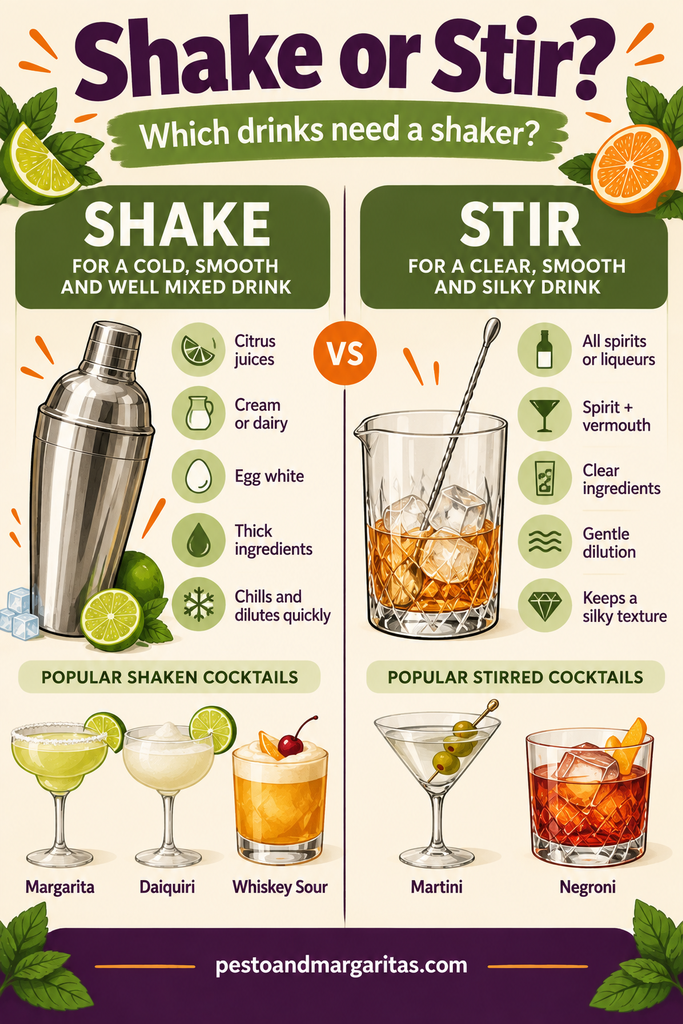
Stir drinks made only from spirits and vermouth, such as a Martini or a Negroni. A mixing glass and bar spoon keep these clear and silky, whereas a shaker clouds them. Fresh juice makes a real difference to the shaken drinks, and if a bag of limes is waiting in the fridge, there are plenty of ways to use up limes and lime juice.
How to use a cocktail shaker
- Add the ingredients to the small tin, or the base of a cobbler. Put juice and syrup in first and the spirit last.
- Fill the shaker about two thirds full with fresh, hard ice. Less ice means more dilution and a warmer drink.
- Seal it. On a Boston, set the large tin over the small one at a slight angle and tap firmly with the heel of your hand. On a cobbler, fit the strainer top and the cap.
- Shake hard for 10 to 15 seconds, until the outside is frosted and very cold.
- Break the seal with a firm tap on the side of the large tin near the join, then strain into the glass. Double strain through a fine mesh strainer if the drink has fruit pulp or herbs.
- Rinse the shaker straight away.
For a drink with egg white, shake once without ice, then add ice and shake again. This gives a thicker, silkier foam.
No shaker? What to use instead
A clean jam jar with a tight screw lid will make one drink. Fill it no more than two thirds, test the seal over the sink with water first, and strain through a small tea strainer. A protein shaker bottle with a built-in grille also works, though it can hold on to flavours, so wash it well.
Avoid sealing two pint glasses together. Glass on glass can crack or shatter under force, which is also why glass Boston tins are the riskiest option.
Cleaning and storing your shaker
Rinse the shaker straight after use, because citrus and sugar set into a sticky film if left. Wash it in warm water with a drop of washing-up liquid and a bottle brush, paying attention to the base and the join. On a cobbler, take the cap and strainer apart.
Once a week, fill it with warm water and 2 tablespoons of white vinegar or lemon juice, leave it for 15 minutes, then scrub and rinse. This clears lingering smells. Wipe the outside with a microfibre cloth and skip bleach and abrasive cleaners, which can pit or scratch stainless steel.
Many stainless steel shakers are labelled dishwasher safe, but hand washing keeps polished and coloured finishes looking good for longer. Do not leave a shaker soaking overnight, especially after citrus or salty drinks. Dry every part completely and store the pieces apart rather than nested, so air can circulate.
Troubleshooting common shaker problems
Most shaker problems have a quick fix once you know the cause.
A stuck or frozen shaker
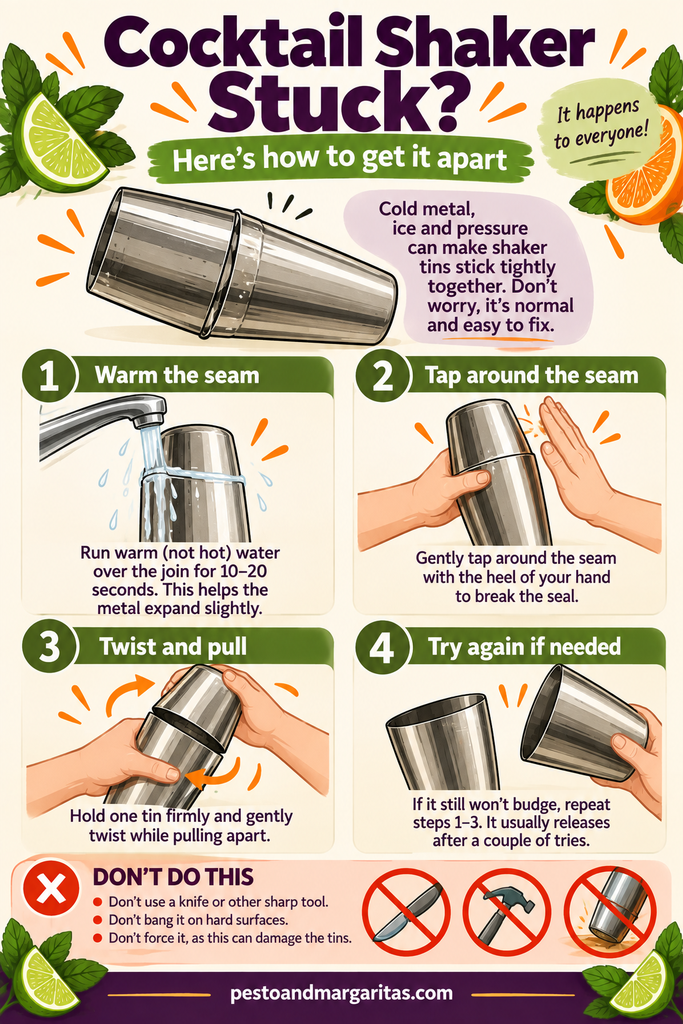
Metal contracts when it is cold and can create a vacuum, which is why cobblers jam and tins sometimes grip. Run warm (not hot) water over the join, or tap around the seam with the handle of a wooden spoon while pulling gently. Do not pry it apart with a knife.
To prevent it, do not press a cobbler cap in hard and give the shaker a minute to warm up between drinks.
A leaking shaker
On a Boston, leaks usually come from the sealing technique. Set the small tin inside the large one at a slight angle, then tap firmly so the tins sit snugly with no gap. On a cobbler, check the strainer top is seated square and do not overfill it.
Test any shaker with ice and a little water before you add expensive ingredients.
A Boston shaker that will not seal
Wet, slippery hands and tins are the usual cause. Dry both and try again, and check for dents in the rim, because a bent tin will not seal properly.
A shaker that is too cold to hold
Wrap the shaker in a bar towel, or wear thin gloves if you are making several drinks in a row. If the ice melts too fast, you probably have too little ice or it is already wet. Use plenty of cold, hard ice, and on a hot day, chill the tins in the freezer first.
When to replace your shaker
Replace it if you see dents that affect the seal, rust spots, cracks, loose joints or smells that cleaning will not shift. If it leaks even with good technique, or the pieces no longer fit together, it has reached the end of its life.
Many people start with a cobbler and move to a Boston or French shaker as their technique improves, and there is no shame in outgrowing your first one.
Bar tools to add next
A shaker is only the start. A Hawthorne strainer is a must for Boston and French shakers, because its spring catches ice and pulp. A jigger gives you accurate measures, which matters more than most people expect.
A mixing glass suits stirred drinks, a muddler releases oils from herbs and fruit, and good ice does more for a cocktail than any gadget. A shaker, a strainer and a jigger will cover the shaken classics in this guide. If you enjoy kitchen kit, our round-up of essential kitchen gadgets is a good next stop.
A short history of the cocktail shaker
Mixing drinks by pouring them between two vessels came first. A New York Tribune journalist described a metal shaker in use in 1848, and in 1872 William Harnett patented an apparatus that mixed six drinks at once. It did not catch on, according to Punch, but Edward Hauck’s three-piece design of 1884 became the cobbler shaker we still use.
Shaker design flourished in the 1930s, a period Difford’s Guide calls the gilded age of the cocktail shaker. The tin-on-tin Boston style has been the bar standard for a long time since.
Cocktail shaker FAQs
What is the best cocktail shaker for beginners?
A cobbler is the easiest to start with, because it is one piece with a built-in strainer. A Boston shaker takes a little practice, but it lasts longer and jams less often. If you plan to make drinks regularly, start with the Boston.
What size cocktail shaker do I need?
For a Boston shaker, buy the standard 18 oz and 28 oz pair. For a cobbler, 500 ml suits one or two drinks and 750 ml suits small batches. Fill any shaker about two thirds full of ice.
How long should you shake a cocktail?
Shake for 10 to 15 seconds, until the outside of the shaker is frosted and very cold. Longer than that adds more water than flavour.
Why does my cocktail shaker get stuck?
The cold air inside contracts and pulls the pieces together. Run warm water over the join or tap the seam gently, then pull the pieces apart. Pause between drinks so the metal warms up.
Can I use a jar instead of a cocktail shaker?
Yes. A clean jar with a tight screw lid will make one drink if you fill it no more than two thirds. Strain through a small tea strainer.
The short version
A weighted Boston shaker with 18 oz and 28 oz tins and a Hawthorne strainer is the best all-round choice. Pick a cobbler for occasional use and a French shaker for a better seal and a nicer look. Whichever you buy, fill it two thirds with ice, shake for 10 to 15 seconds and wash it straight away.
Continue reading
Put your new shaker to work with these cocktail round-ups:
- 13 best gin cocktails, for when you want something crisp and botanical.
- 15 tequila cocktails, beyond the Margarita.
- 15 vodka cocktails, from simple mixers to showpieces.
- Frozen cocktails, for the drinks that need a blender instead.