How to Season Food Properly: Salt, Timing and Fixes
Most home cooks have had the same two experiences: a dish that tastes flat no matter what you do to it, and a dish that suddenly tips into too salty. Both come down to the same skill. Learning how to season food properly is the quickest way to make everything you cook taste better, and it needs no fancy equipment or secret recipes.
As an Amazon Associate I earn from qualifying purchases and sometimes recommend products from other sellers at no extra cost you. For more details see my disclosure policy and privacy policy.
This guide is built around three decisions you make every time you cook: which salt to use, when to add it, and how to rescue a dish that is bland or over-seasoned. By the end, you should be able to season confidently without a recipe holding your hand.
🧂 What Seasoning Actually Means
Seasoning is not just sprinkling salt over a finished plate. It is the process of building flavour in layers, tasting as you go, and adjusting until everything tastes balanced.
Think of it as a small toolkit with a clear order of importance:
- Salt: the foundation. It makes food taste more like itself.
- Acid: lemon juice, lime, vinegar or wine. It brightens and lifts.
- Pepper and heat: black pepper, chilli and other warming spices.
- Herbs and spices: the personality of the dish.
- Fat and sweetness: these round off edges and balance sharpness.
The big idea is to season in layers rather than all at the end. A pinch of salt on the onions, another when the sauce simmers and a final adjustment at the table builds much more depth than one large dose at the finish.
It also helps to taste constantly. A clean teaspoon, used often, is the most useful seasoning tool you own.
🥄 Choose Your Salt
Not all salt is the same, and that matters more than you might think. Different salts have different crystal sizes, so a teaspoon of one can be much saltier than a teaspoon of another.
Here are the salts that matter for everyday cooking:
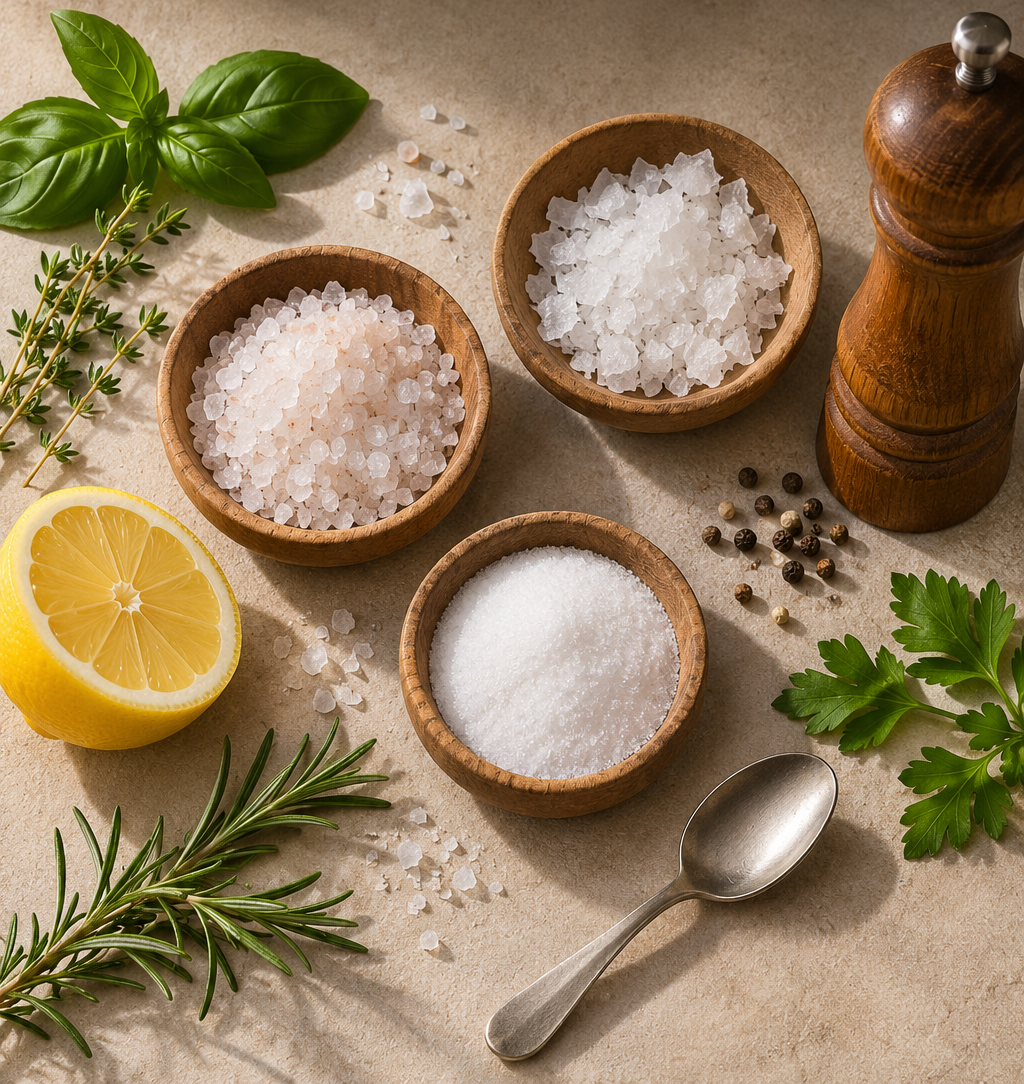
- Table salt: fine, dense and very salty by volume. It dissolves quickly and is easy to measure, but it can taste harsh if you are heavy-handed.
- Kosher salt: coarser flakes that are easy to pinch and spread. It is popular with cooks in the US, and it is a good all-round choice for seasoning meat, vegetables and water.
- Fine sea salt: similar in saltiness to table salt, with a slightly cleaner taste. Good for baking and for dishes where you need it to dissolve.
- Flaky finishing salt: thin, crunchy flakes that you add at the end for texture and a burst of salt. It is not for cooking into a dish.
You will also see Himalayan salt, black salt, smoked salt and others. They are fun to try, but you do not need any of them for good everyday seasoning.
Why Diamond Crystal and Morton Measure Differently
If you cook from American recipes, you will notice two big kosher salt brands: Diamond Crystal and Morton. They are both called kosher salt, but they do not measure the same.
Diamond Crystal has light, hollow flakes, so a teaspoon contains less salt by weight. Morton has denser crystals, so a teaspoon is noticeably saltier.
As a rough guide, if a recipe calls for 1 teaspoon of table salt, you might use about 1¼ teaspoons of Morton kosher salt or about 2 teaspoons of Diamond Crystal. The exact weights vary a little by brand and how you fill the spoon, so treat these as starting points and taste as you go.
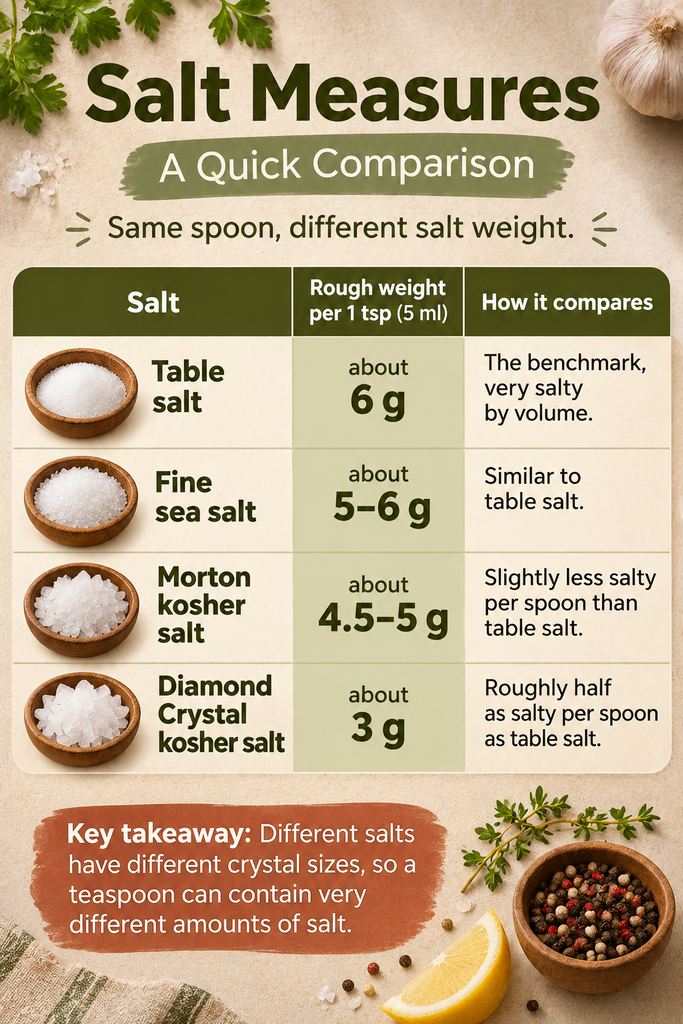
Salt Measures: A Quick Comparison
This table shows roughly how the same teaspoon of different salts compares. These are approximate guides, not exact figures.
| Salt | Rough weight per 1 tsp (5 ml) | How it compares |
|---|---|---|
| Table salt | about 6 g | The benchmark, very salty by volume |
| Fine sea salt | about 5 to 6 g | Similar to table salt |
| Morton kosher salt | about 4.5 to 5 g | Slightly less salty per spoon than table salt |
| Diamond Crystal kosher salt | about 3 g | Roughly half as salty per spoon as table salt |
The easiest way to avoid confusion is to weigh your salt. A digital kitchen scale takes the guesswork out of it, especially in baking and brines.
Which Salt to Use for What
A simple system keeps things easy:
- Everyday cooking: kosher salt or coarse sea salt. You can pinch it, see it and control it. A bag of coarse sea salt is a good all-purpose option.
- Pasta water, brines and boiling vegetables: any plain salt works, because it dissolves.
- Baking: fine salt, because it disperses evenly.
- Finishing: flaky sea salt, sprinkled on at the end.
A quick note for UK readers: Diamond Crystal and Morton are US brands, and they are not always easy to find in UK shops. If you cannot get them, use coarse or flaky sea salt and weigh it instead. Check the shelf in larger supermarkets or look online.
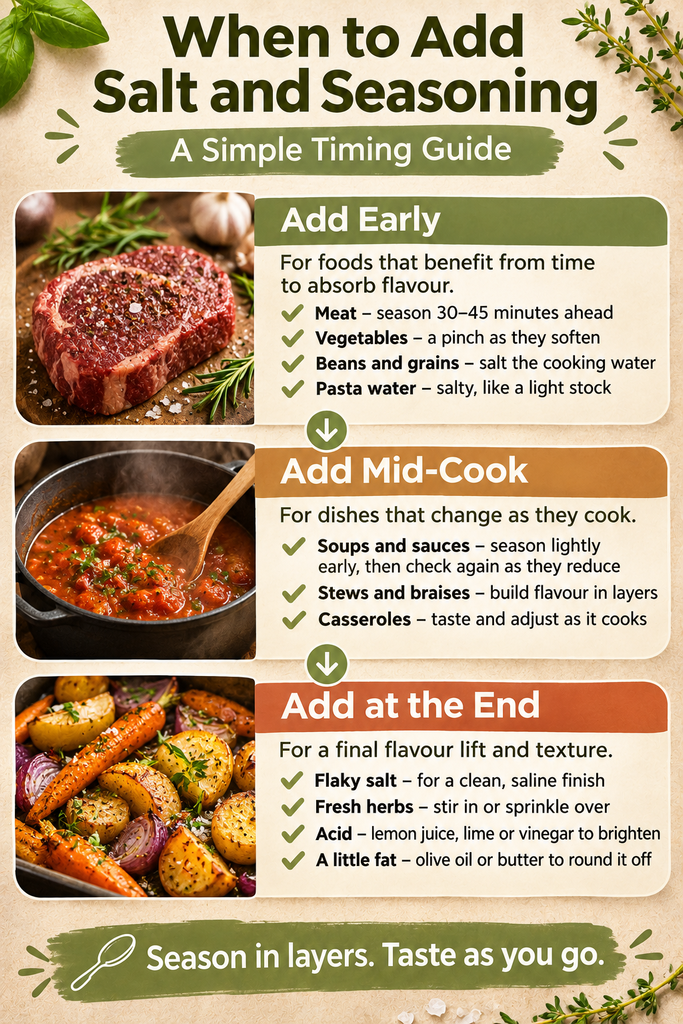
⏱️ When to Add Salt and Seasoning
Timing matters almost as much as quantity. Salt takes time to work its way into food, so adding it early gives a deeper, more even flavour.
Add early for foods that benefit from time to absorb flavour:
- Meat: salt steaks, chops and chicken before they go in the pan, even 30 to 45 minutes ahead. It seasons the meat more deeply and helps with browning.
- Vegetables: a pinch on onions as they soften draws out moisture and flavour.
- Beans and grains: salt the cooking water so the food seasons as it cooks.
- Pasta water: it should taste noticeably salty, like a lightly salted stock, because this is your only chance to season the pasta itself.
Add mid-cook for foods that change as they cook:
- Soups and sauces: season lightly early on, then check again as the liquid reduces. Reducing concentrates salt, so a sauce that tasted perfect at the start can turn salty by the end.
- Stews and braises: add a little at the start, then adjust at the end.
Add at the end for finishing touches:
- Flaky salt: sprinkle it over steaks, salads, roasted vegetables and even desserts.
- Fresh herbs and acid: add these just before serving, so they stay bright.
Ingredients That Change How Much Salt You Need
Some ingredients bring their own salt, so adjust accordingly:
- Stock and bouillon: often very salty. Use a lighter hand with added salt until the end.
- Cheese: Parmesan, feta and blue cheese add plenty of salinity.
- Soy sauce, fish sauce and Worcestershire sauce: a little goes a long way. If you are short of one of them, our guides to soy sauce substitutes and Worcestershire sauce substitutes can help.
- Cured meats: bacon, ham and pancetta season a dish as they cook.
When a recipe uses several of these, hold back on the salt and taste before adding more.
🍋 Beyond Salt: Acid, Pepper, Herbs and Spices
Many dishes that taste flat do not need more salt at all. They need balance. That is where acid, heat, herbs and spices come in.
Acid
A squeeze of lemon, a splash of vinegar or a spoonful of tangy yoghurt can transform a dull dish. Acid brightens flavours and makes them taste cleaner, which is why a finished soup or sauce often improves with a small squeeze at the end.
Use acid in small amounts and taste after each addition. If you are out of lemon, our guide to lemon juice substitutes offers easy swaps, and our types of vinegar guide helps you choose the right bottle.
Pepper and Heat
Black pepper adds warmth and a little bite. Grind it fresh for the best flavour, and add it near the end for a sharper taste or earlier for a mellower one.
If you like heat, chilli flakes, cayenne and fresh chillies all do the job. Our guide to types of chilli peppers explains the differences and the heat levels.
Herbs
Hardy herbs such as thyme, rosemary and bay stand up to long cooking, so add them early. Soft herbs such as parsley, coriander (cilantro), basil and chives lose their freshness when heated, so add them at the end.
If you want to explore how herbs and spices can add flavour, our post on adding herbs and spices is a good next read.
Spices
Whole and ground spices behave differently:
- Ground spices release flavour quickly and can burn, so add them to hot fat for 20 to 30 seconds, then add liquid.
- Whole spices need longer, so they suit stews, curries and rice dishes.
- Blooming: frying spices briefly in oil or butter wakes up their flavour. Many cooks do this at the start of a curry, chilli or soup.
If a recipe calls for a spice you do not have, our spice substitute guide will help you swap it.
Fat and Sweetness
Fat carries flavour and softens harsh edges, which is why a knob of butter or a drizzle of olive oil can rescue a sharp sauce. A pinch of sugar or a little honey can balance acidity, especially in tomato-based dishes.
👅 How to Taste and Adjust
Tasting is a skill, and it improves quickly with practice. Use a clean spoon each time, and let the food cool slightly so you can actually taste it.
Ask yourself one simple question each time: what is missing?
- It tastes flat or dull: it probably needs salt, or acid. Add a small pinch of salt first, stir, wait a few seconds, then taste again.
- It tastes salty: it needs dilution or balance. See the next section.
- It tastes sharp or sour: it needs fat, a touch of sweetness or a little more cooking time.
- It tastes bitter: it may need a pinch of salt, which can soften bitterness, or a little sweetness.
- It tastes muddy, with no clear flavour: it often needs acid, or fresh herbs on top.
Add seasoning gradually. You can always add more, but removing it is harder. A good habit is to add half what you think you need, taste, and then decide.
If you are cooking for others, season a little less than you would for yourself, and put salt and pepper on the table. People can adjust their own plate.
A simple tasting exercise: stir a good pinch of salt into a cup of plain tomato juice, then taste it next to an unsalted cup. Do the same with a squeeze of lemon. Seeing (and tasting) what salt and acid each do on their own is the quickest way to learn which one a dish is asking for. Try it once and you will start to notice the difference in everything you cook.
Season in layers: a pinch with the onions, a pinch when the liquid goes in and a final adjustment at the end builds more depth than one big dose of salt at the finish. Taste after each addition, because stocks, cheese, cured meats and sauces from a jar all bring their own salt to the pot.
🛟 How to Fix Over-Seasoned Food
Everyone over-seasons occasionally. Do not throw the pot away. There are sensible ways to rescue most dishes.
If It Is Too Salty
- Dilute it: add more of the unsalted base, such as water, unsalted stock, tomatoes or cream. This is the most reliable fix.
- Add unsalted bulk: extra rice, pasta, potatoes, beans or vegetables soak up flavour and spread the salt over a bigger portion.
- Balance with acid: a squeeze of lemon or a splash of vinegar can make a salty dish taste less sharp.
- Add fat or dairy: a little cream, yoghurt, butter or olive oil can soften the impression of saltiness.
- Add a touch of sweetness: a pinch of sugar or a little honey can help balance.
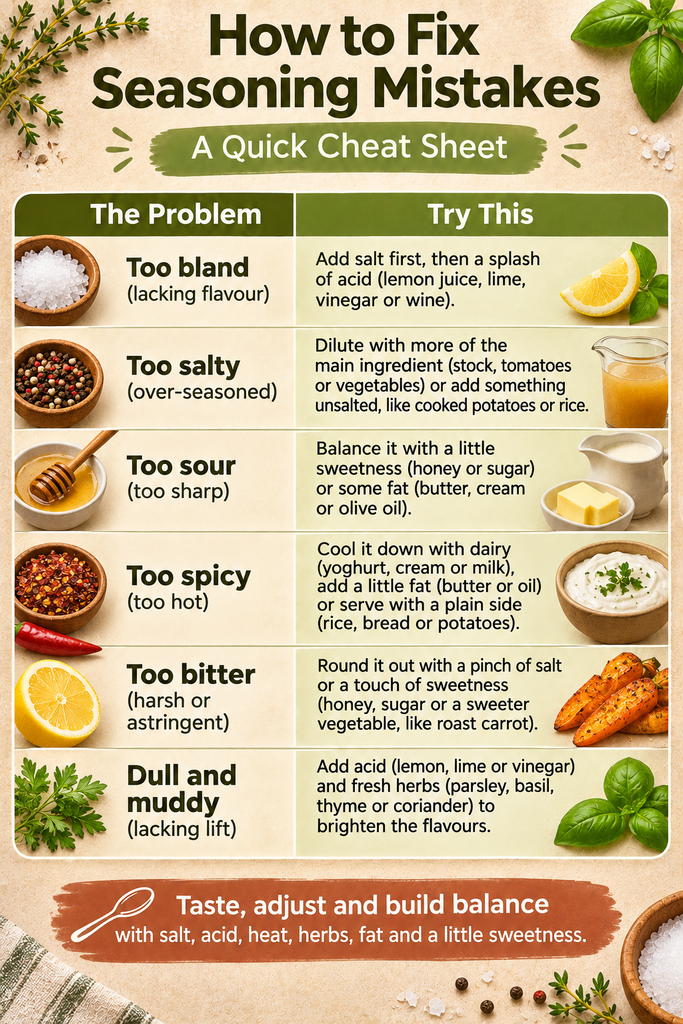
You may have heard that dropping a raw potato into a salty soup will absorb the excess. This is a popular kitchen trick, but there is no good evidence it works, because the potato absorbs liquid as well as salt, and the saltiness stays about the same. Dilution is the proven fix.
If There Is Too Much Pepper or Spice
- Add dairy or fat: cream, yoghurt, coconut milk or butter calm heat.
- Add sweetness and bulk: a little sugar, extra vegetables or rice help dilute the heat.
- Serve with cooling sides: plain rice, bread or a yoghurt dip lets each person adjust.
If It Is Too Acidic
- Add a pinch of sugar or honey: it balances sourness quickly.
- Add fat: butter or oil softens sharp edges.
- Dilute: a splash of water or stock reduces the punch.
If It Is Too Bland
- Add salt first: a small pinch, stirred in and tasted.
- Add acid: lemon or vinegar often wakes a dull dish.
- Add umami: a spoonful of tomato paste, a splash of soy sauce or some grated Parmesan builds depth.
- Finish with fresh herbs or a drizzle of good oil: these give a lift right at the end.
📋 Quick-Reference Seasoning Cheat Sheet
Keep this table handy for fast decisions in the kitchen.
| Problem | Likely fix |
|---|---|
| Tastes flat | A pinch of salt, then a squeeze of acid |
| Too salty | Dilute with unsalted liquid, add bulk, balance with acid or fat |
| Too sharp or sour | A pinch of sugar, a little fat, or more cooking time |
| Too spicy | Add dairy, fat, sweetness or a plain side |
| Bitter | A small pinch of salt, or a little sweetness |
| Dull and muddy | Acid and fresh herbs at the end |
| Boiled vegetables or pasta | Salt the water well before adding the food |
| Steaks or chops | Salt 30 to 45 minutes ahead, or just before cooking |
🍽️ Seasoning in Action: Short Examples
The best way to practise is to apply these ideas to everyday cooking. Here are a few short examples.
A simple soup: season the onions early, add herbs while it simmers, then finish with a squeeze of lemon. Try this with our parsnip soup with thyme and pancetta or a spiced carrot and lentil soup, where spices and herbs do plenty of the work.
Tomato-based dishes: tomatoes need salt and sometimes a pinch of sugar to balance acidity. Our guide to homemade tomato soup is a good place to practise.
Steak and meat: salt well in advance, and finish with flaky salt after it has rested. Our reverse seared strip steak recipe shows the timing in practice.
Roast vegetables: toss them with oil and a good pinch of salt before roasting so it clings and helps them brown, then finish with lemon juice or a few chopped herbs once they are out of the oven.
Seafood: delicate foods take less salt, and a bright finish works best. Our lemon garlic shrimp (prawns) with asparagus uses lemon at just the right moment.
🥄 The Takeaway
Seasoning well is a habit, not a talent. Choose a salt you trust, and weigh it if you can. Season early and in layers, taste often, and use acid, herbs and spices to build balance, not just more salt.
When things go wrong, dilute, balance and adjust rather than starting again. With practice, you will season by instinct, and your everyday cooking will taste noticeably better.