
Cooking Oils Guide: Which Oil to Use and When
Most kitchens end up with three or four bottles of oil and only a vague sense of which one to reach for. That is usually because oil advice tends to come as either a long list of every oil that exists, or a single “healthiest oil” verdict that does not actually help you decide what to pour into a hot pan tonight.
As an Amazon Associate I earn from qualifying purchases and sometimes recommend products from other sellers at no extra cost you. For more details see my disclosure policy and privacy policy.
This guide skips both of those approaches. Instead, it sorts oils by the job in front of you, so picking a bottle becomes a quick decision rather than something that needs a chart memorised in advance. There is no single “best” oil in this guide, since the right choice depends entirely on what you are cooking, not on a fixed ranking.
🌡️ What Smoke Point Actually Means
Smoke point is the temperature at which an oil starts to break down and visibly smoke, and it matters because an oil pushed past its smoke point turns bitter and starts throwing off compounds you do not want in your food. Every oil has one, and it is not a fixed number so much as a range, since two bottles of the “same” oil can behave differently depending on how they were processed.
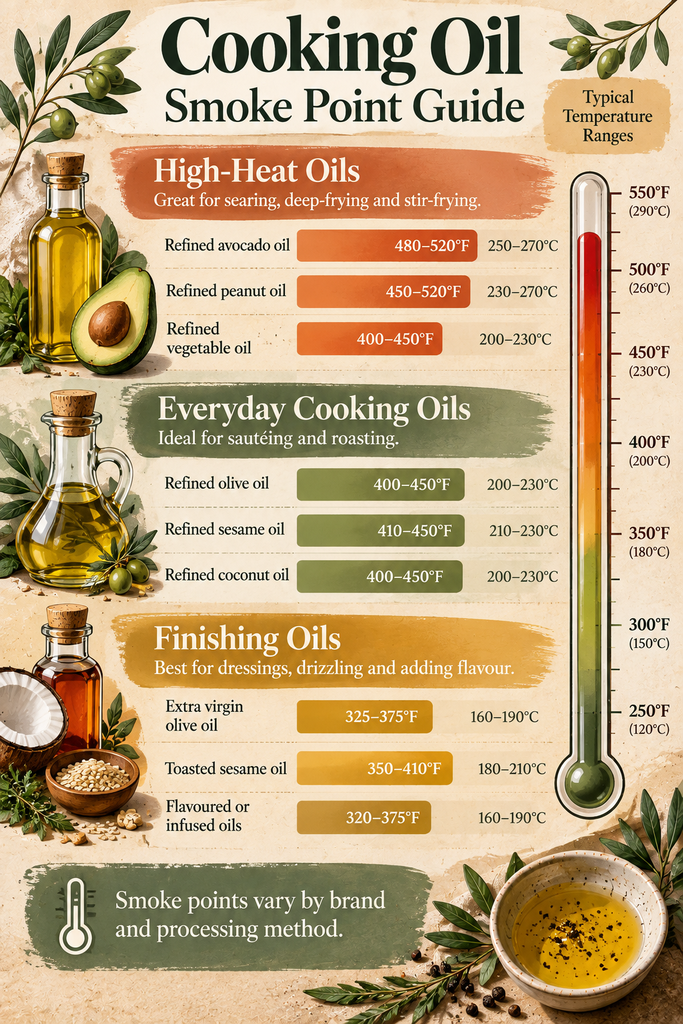
That is where refined versus unrefined makes the real difference. Refined oils have been filtered and processed to remove impurities, which pushes their smoke point noticeably higher, often into the 400 to 500°F (roughly 200 to 260°C) range. Unrefined, cold-pressed, or “virgin” oils keep more of their natural flavor and color, but that also means they smoke at a lower temperature, frequently sitting somewhere in the 300 to 375°F (150 to 190°C) range instead.
Neither version is better across the board. Refined oils are the right tool for high heat, while unrefined oils are worth the trade-off when flavor matters more than temperature, such as in a dressing or a finishing drizzle.
Going past an oil’s smoke point matters for two practical reasons. The oil itself turns bitter and the flavor of whatever you are cooking suffers along with it, and a smoking pan is also simply harder to cook in, since it fills the kitchen with smoke and makes it much harder to judge color and browning as you go. Treat visible smoke as a sign to pull the pan off the heat for a moment, not as a normal part of high-heat cooking.
🧈 Where Butter and Other Fats Fit In
Oil is not the only fat in the kitchen, and it is worth knowing when something else is actually the better choice. Butter brings a richness and flavor that no cooking oil quite replicates, but its milk solids scorch at a relatively low temperature, which is why a recipe that wants both butter’s flavor and a hotter pan often calls for a mix of butter and oil together, or for ghee (clarified butter with the milk solids removed), which tolerates noticeably higher heat than regular butter while keeping much of that same flavor.
As a rough rule, reach for oil when the job calls for higher heat or a neutral base, and reach for butter or ghee when the flavor it adds is the point, such as finishing a pan sauce or basting a steak in the last minute of cooking.
🔥 Oils by Job
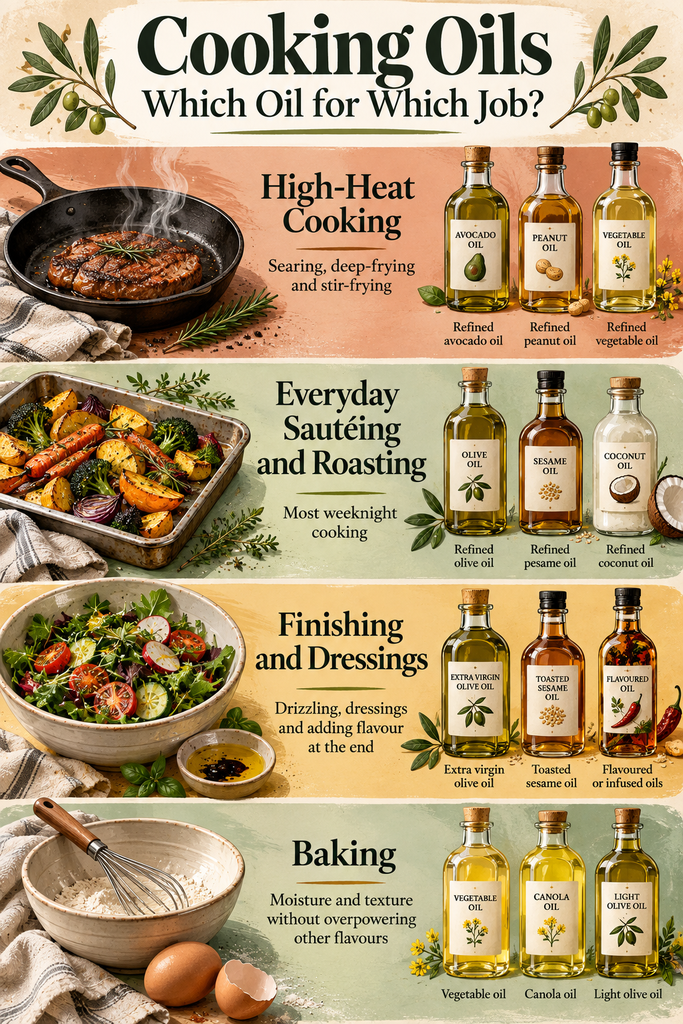
High-heat cooking (searing, deep-frying, stir-frying): reach for a refined oil with a high smoke point, such as refined avocado oil, refined peanut oil, or a plain refined vegetable or canola oil blend. These can comfortably handle 400°F and above without breaking down, which is exactly what a hard sear or a deep fryer demands.
Everyday sautéing and roasting: this is the wide middle ground where most weeknight cooking actually happens, and it is more forgiving than high-heat cooking. Refined olive oil, refined sesame oil, and refined coconut oil all sit comfortably in the 400 to 450°F range, more than enough for roasting vegetables or sautéing over medium-high heat.
Finishing and dressings: this is where unrefined, cold-pressed oils earn their keep, since you are not heating them at all. Extra virgin olive oil, toasted sesame oil, and flavored or infused oils like a chili-infused olive oil all bring real character to a finished dish precisely because they have not been cooked down.
Baking: neutral, refined oils (vegetable, canola, or a light olive oil) are the standard choice here, since you generally want the oil to add moisture and texture without competing with the other flavors in the bake.
🥑 Flavor and Texture: Neutral vs. Characterful
Some oils are built to disappear into a dish, and some are built to be noticed. Refined vegetable, canola, and light olive oils are all genuinely neutral, which is exactly why they are the default choice for baking and everyday cooking where you do not want the oil competing with anything else.
Extra virgin olive oil, toasted sesame oil, and most nut oils sit at the other end of the spectrum. Toasted sesame oil in particular is intensely aromatic even in small amounts, which is why it almost always shows up as a finishing drizzle rather than the main cooking fat in a dish. A few drops stirred in at the very end will carry further than the same amount added at the start of cooking, since heat mellows its aroma considerably.
If you already have a favorite single-oil guide, our coconut oil guide covers that one specifically in more depth than this umbrella post goes into, and our olive oil substitutes guide is the place to go if you are looking for a swap rather than a full oil-by-oil breakdown.
🍳 Getting the Basics Right in Your Kitchen
A well-seasoned pan matters just as much as the oil you put in it. If you are still working out which pan does what, our guide to what a skillet pan actually is and how to use one is a useful companion to this post, since the right pan and the right oil for the job go hand in hand.
If you are building out a kitchen from scratch and trying to work out what is actually worth buying versus what you can skip, our roundup of essential kitchen gadgets covers the bigger picture beyond oils specifically.
🧴 Storage, Shelf Life, and Spotting Rancid Oil
Oil does not last forever, and heat, light, and air are the three things that speed up its decline. Store oils in a cool, dark cupboard rather than next to the stove, where the ambient heat from cooking will shorten their shelf life noticeably faster than room-temperature storage elsewhere in the kitchen.
Most refined oils keep well for around a year unopened and several months once opened. Unrefined and cold-pressed oils, extra virgin olive oil included, have a shorter window, typically best used within a few months of opening for the freshest flavor.
Rancid oil has a distinct smell, often described as crayon-like, waxy, or faintly like old paint, and the flavor follows the same unpleasant direction. If a oil smells “off” in any way compared to when you bought it, or tastes bitter or sour rather than clean, it is time to replace it rather than cook with it.
Reusing frying oil safely: if you have deep-fried and want to reuse the oil, let it cool completely, then strain it through a fine sieve or cheesecloth to remove any food particles, which are what cause oil to break down faster on a second use. Store the strained oil in a sealed, labelled container and use it again within a few uses, discarding it once it darkens noticeably, develops a strong smell, or starts foaming more than it did originally.
🧺 What to Keep in a Small Kitchen
If space or budget means you cannot stock every oil mentioned above, a small, well-chosen set covers almost everything most home cooks actually need:
- A refined, high-heat neutral oil (vegetable, canola, or refined avocado oil) for searing, frying, and baking.
- A good olive oil, ideally one bottle for cooking and a slightly better bottle reserved for finishing and dressings, if your budget stretches to two.
- One characterful oil for finishing, such as toasted sesame oil or a flavored oil, kept specifically for the moments where a few drops make a real difference.
That short list will not cover every specialty use case, but it is genuinely enough to cook the overwhelming majority of everyday meals well.
❓ A Few Common Questions
Can I mix different oils in the same pan? Yes, and it is a common way to get the best of both. A splash of a neutral high-heat oil alongside a small amount of butter, for example, lets you sear at a higher temperature than butter alone could handle while still picking up some of its flavor.
Does a higher price always mean a better oil? Not necessarily. Price often reflects how the oil was pressed and where it was sourced rather than how well it performs for a given job. A mid-range refined vegetable oil does its job in a hot pan just as reliably as an expensive one, and the extra cost of a premium bottle is usually better spent on a good finishing oil, where flavor differences are actually noticeable.
Is it fine to cook with extra virgin olive oil? For most everyday sautéing and roasting at moderate heat, yes, and plenty of home cooks do it without issue. It is simply not the right choice for a hard sear or deep-frying, where its lower smoke point becomes a real limitation rather than a minor one.
How do I know if my pan is at the right temperature for the oil I’m using? A shimmer across the surface of the oil is a good sign it is hot enough for sautéing. Visible smoke means you have gone past that point for whichever oil is in the pan, so ease the heat back rather than pushing through it.
📋 Quick-Pick Reference Table
| Oil | Smoke Point Range | Flavor | Best Uses |
|---|---|---|---|
| Refined vegetable / canola | 400–475°F (200–245°C) | Neutral | High-heat cooking, baking |
| Refined avocado oil | 480–520°F (250–270°C) | Neutral, very mild | Searing, deep-frying |
| Refined olive oil | 390–470°F (200–245°C) | Mild, slightly fruity | Sautéing, roasting |
| Extra virgin olive oil | 300–320°F (150–160°C) | Fruity, peppery | Dressings, finishing, low-heat cooking |
| Refined sesame oil | 400–410°F (205–210°C) | Mild nutty | Sautéing, stir-frying |
| Toasted sesame oil | 320–350°F (160–175°C) | Intensely nutty | Finishing, drizzling |
| Refined coconut oil | 400°F (205°C) | Neutral | Baking, roasting |
| Refined peanut oil | 440–450°F (225–230°C) | Mild nutty | Deep-frying, stir-frying |
Ranges above are typical figures for each category rather than exact numbers, since smoke points genuinely vary by brand and processing method.
