
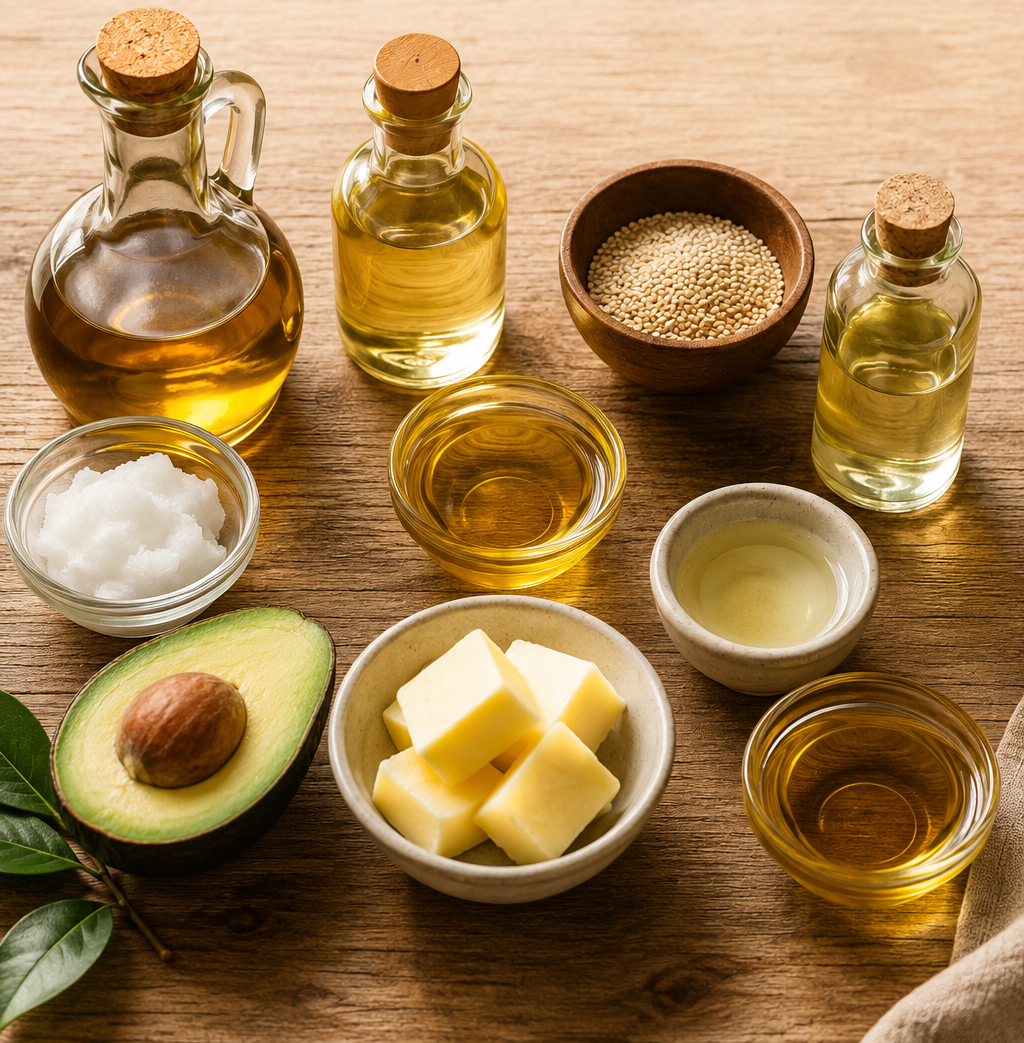
Substitutes for Olive Oil: What to Use in Cooking, Baking and Salads
Run out of olive oil halfway through a recipe? Watching the budget and want something cheaper for everyday cooking? Got a guest who’s allergic, or you’re just trying to cut back on added oils without giving up flavour?
As an Amazon Associate I earn from qualifying purchases and sometimes recommend products from other sellers at no extra cost you. For more details see my disclosure policy and privacy policy.
Whatever the reason, you don’t need to put the pan down and drive to the shops. Most kitchens already have something that’ll do the job.
This is a practical, no-fuss guide to swapping out olive oil wherever it shows up — frying and roasting, salad dressings, baking, and pesto or sauces — with straightforward ratios so you’re not guessing. There’s no “olive oil is bad, use this instead” here.
It’s simply about having options, because sometimes the fanciest bottle in the cupboard isn’t the most convenient one.
Why You Might Reach for Something Else
There are plenty of perfectly good reasons to swap out olive oil that have nothing to do with it being a lesser ingredient. Maybe you’ve genuinely run out and don’t fancy a supermarket run mid-recipe. Maybe a good bottle of extra-virgin has crept up in price and you’d rather save it for drizzling, not deep-frying.
Maybe someone at the table has an allergy or intolerance, or you’re simply cutting back on your overall oil intake and want a lighter option here and there. None of these are wrong reasons — it’s just about choosing what works for the dish and the day.
It also helps to remember that “olive oil” itself isn’t one single thing in the kitchen. A robust, peppery extra-virgin bottle you’d use for dipping bread is a very different ingredient from the lighter, more refined olive oil often used for everyday frying — and neither is quite the same job as the “light” or “pure” olive oil sold specifically for higher-heat cooking.
Once you think of olive oil as a family of products doing slightly different jobs, it’s much easier to see why there isn’t one single substitute that replaces it everywhere. Instead, the right swap depends on what you’re actually asking the oil to do in that particular recipe.
A Quick Word on Smoke Point and Flavour
Two things matter when you’re picking a substitute: how hot the oil can get before it starts to smoke and break down (its smoke point), and how strong its own flavour is.
- For high-heat jobs like roasting or pan-frying, look for a higher smoke point so it doesn’t scorch and turn bitter.
- For dressings, where the oil is doing more of the talking, flavour matters more than heat tolerance.
- For baking, you’re usually after something fairly neutral so it doesn’t compete with the other ingredients — though a little richness never hurt a loaf cake.
Keep those two questions in mind — “how hot will this get?” and “do I want this to taste of something?” — and picking a substitute gets a lot easier.
Roughly speaking, refined oils with milder flavours (rapeseed, sunflower, refined avocado oil) tend to cope better with high, direct heat. Richer, more flavourful options like extra-virgin olive oil, walnut oil or butter are happier at gentler temperatures or finishing a dish rather than starting it.
It’s not an exact science — plenty of good cooks roast with butter all the time — but it’s a useful rule of thumb if you’re not sure where to start.
When You’re Frying and Roasting
This is where you’ve got the most flexibility, because most everyday oils and fats swap in at a simple 1:1 ratio.
- Avocado oil — the closest like-for-like swap. High smoke point, mild flavour, and works beautifully for roasting vegetables, grilling, and dressings alike.
- Rapeseed (canola) oil and sunflower oil — the everyday workhorses. Neutral in flavour and happy at high heat, so they’re ideal for stir-fries, roast potatoes, or getting a traybake of chicken thighs properly golden.
- Ghee or clarified butter — a richer, slightly nutty result at the same 1:1 ratio. Good for roasting root vegetables or basting meat, and it can take slightly higher heat than regular butter.
- Coconut oil — works well for gentle sautéing, though its subtle sweetness is more noticeable in savoury dishes. It’s solid at room temperature, so let it melt first.
- Tallow or other animal fats — a more traditional option for high-heat roasting, think crisp roast potatoes. They bring a more pronounced flavour, so save them for hearty, savoury dishes.
A couple of everyday examples to make this less abstract: for a traybake of chicken thighs and vegetables, rapeseed or sunflower oil will do exactly what olive oil would, without you noticing the difference once everything’s roasted and golden. For crisp roast potatoes, ghee or a light dusting in avocado oil gets you that same crunchy, well-browned edge.
And if you’re simply pan-frying onions and garlic as the base for a sauce, almost any of the oils above will happily stand in — this is the most forgiving swap on the list.
When You’re Making Salad Dressing
Dressings are where flavour matters most, since there’s nothing to hide behind.
- Rapeseed, sunflower or avocado oil — an easy like-for-like swap at 1:1 that won’t clash with your vinaigrette.
- Walnut or sesame oil — for a bit more personality. Walnut oil is lovely with a sharper vinegar and some crumbled cheese, while sesame oil brings a completely different character to Asian-inspired salads.
- Starch-thickened water or broth — if you’re cutting back on oil altogether. A pinch of cornflour or arrowroot whisked into warm water or stock mimics some of that clingy, coating texture oil normally gives you.
- Yoghurt or tahini — whisk a spoonful into your vinaigrette base for body and a bit of extra flavour, without the oil.
For a classic, no-oil approach, try the Best Summer Salad Dressing Recipes on Pesto & Margaritas for ideas built around citrus, yoghurt and herbs rather than a big glug of oil.
When You’re Baking
This is the one area where a straight 1:1 swap isn’t always your best bet, because olive oil is pure fat while butter — the most common alternative — also carries water and milk solids.
- Melted butter — go roughly 1:1, though your batter may end up very slightly denser since butter isn’t quite as fluid as oil. (Doing the swap the other way around — substituting for butter rather than for oil? The ratio flips, so it’s worth checking a dedicated guide like our piece on butter substitutes for the full breakdown.)
- Neutral oils — rapeseed, sunflower, a mild avocado oil — swap in at 1:1 with almost no impact on flavour or texture. The easiest option if you’re just out of olive oil and don’t want to overthink it.
- Fruit purées — applesauce, mashed banana or pumpkin purée can replace some or all of the oil in cakes and quick breads, keeping things moist while cutting the fat content.
Fruit purées will change the flavour and texture a little — banana bread is the obvious home for mashed banana, for instance — but in the right recipe, that’s a bonus rather than a compromise. Start by replacing half the oil and see how you get on before going further.
When You’re Making Pesto and Other Sauces
Pesto leans on olive oil for both its flavour and its silky texture, so the swap here is slightly more about technique than a straight substitution.
- Avocado oil — the simplest option. Use it at the same ratio as the olive oil in your recipe for a similar consistency with a milder, more neutral taste.
- Walnut oil — if you want to lean into a nuttier, more autumnal flavour, particularly nice tossed through a wholemeal pasta.
- Avocado (the fruit, not the oil) — blend in half an avocado with a splash of water or plant milk in place of the oil, for a wonderfully creamy, vibrant green sauce with a fraction of the fat.
- Tahini — loosened with a little water or pasta cooking water, it gives your sauce a warm, slightly toasty note that’s lovely with basil or kale.
Whichever route you take, don’t skip the pasta water when you’re loosening your sauce to coat pasta. It does a lot of the work that a generous glug of oil would otherwise be doing, whichever fat you’ve chosen.
For more ideas on building a pesto from scratch, our guide on how to make pesto (and what to use it for) covers the classic method in more detail.
A Few Common Questions
Can I use vegetable oil instead of olive oil in pretty much anything? For the most part, yes. Plain vegetable oil is neutral enough to swap in at a 1:1 ratio for frying, roasting and baking. It won’t have the same character as extra-virgin olive oil in a dressing you’re serving raw, but for anything that’s being cooked, it’s one of the simplest swaps there is.
What’s the best all-round substitute if I only want to buy one thing? Rapeseed (canola) oil is hard to beat as a single bottle that covers frying, roasting, baking and dressings. It’s inexpensive, widely available, and neutral enough not to clash with whatever else is in the dish. Avocado oil is a close second if you don’t mind spending a little more.
Does the substitute change how healthy the dish is? That depends on the fat you choose and how much of it you use, and it’s worth remembering that all fats — including olive oil — are fine as part of a varied diet. If you’re specifically trying to use less added fat overall, the purées, broths and yoghurt-based options above are the ones to reach for.
Can I mix two substitutes together? Absolutely, and it’s a great way to balance flavour and cost. A 50/50 blend of a mild oil (rapeseed or sunflower) with something more flavourful (walnut oil, a robust avocado oil) gives you character without overwhelming the dish.
Will my finished dish taste noticeably different? Sometimes, sometimes not. Swap a neutral oil for another neutral oil in a roast dinner or a traybake and most people won’t clock the difference at all.
Swap it in something where olive oil is doing a starring role — a simple pasta with just garlic, chilli and parmesan, say — and you probably will notice, even if the result is still delicious in its own way. If a dish leans heavily on olive oil’s flavour, reach for avocado oil or a light drizzle of whatever olive oil you do have left, rather than something more neutral.
Your Quick Swap Cheat Sheet
If you’re in a hurry, here’s the short version:
- Frying and roasting: avocado, rapeseed or sunflower oil (1:1), or ghee for extra richness
- Salad dressings: any neutral oil (1:1), or a nut oil for more flavour; starch-thickened water or yoghurt if you’re cutting oil out
- Baking: melted butter or a neutral oil (roughly 1:1); fruit purée if you want to reduce the fat
- Pesto and sauces: avocado oil (1:1), or blended avocado/tahini for an oil-free version
Which Olive Oil Substitute Is Right for You?
What are you making?
Do you want it to taste neutral, or don’t you mind some extra flavour?
Are you trying to cut back on oil altogether, or just swapping one for another?
A Few Practical Tips Before You Start Swapping
A couple of things make substituting less of a gamble. Test in small batches — if you’re trying a new fat in a bake for the first time, halve the recipe or try it in muffins before you commit a whole layer cake to the experiment.
Most oils also keep best stored in a cool, dark place, away from the heat of the hob, so they don’t turn rancid before you get to use them. And if you’re not sure how a substitute will taste, a 50/50 blend with your usual oil is a gentle way to ease into it without changing a dish too drastically.
At the end of the day, this isn’t about ranking oils and fats against each other — it’s about having a flexible kitchen where a missing ingredient doesn’t mean a missing dinner. Keep a couple of these on hand (a bottle of rapeseed oil and a block of butter will cover most situations) and you’ll rarely be caught out.


